-

How to Create Your Own Academic Advisor AI Agent
academic advisor AI, AI agents, AI in Education, AlmmaGPT, curriculum design, EdTech, faculty productivity, Higher Education, pedagogy, teaching with AIAn Academic Advisor AI Agent is neither a chatbot nor a shortcut.
It is a persistent, role‑aware assistant designed to support you in your work as a professor, instructor, or educator.
When designed correctly, this agent helps you:
- Think through curriculum and course design
- Refine pedagogy and assessment strategies
- Prepare advising conversations and academic plans
- Translate institutional constraints into workable decisions
This guide walks you step‑by‑step through creating your own Academic Advisor AI Agent in AlmmaGPT.
No technical background required.
Step 1 – Clarify the Role of Your Academic Advisor AI
Before creating the agent, be clear about what it is and what it is not.
Your Academic Advisor AI:
- Supports your thinking — it does not replace your judgment
- Operates within academic norms, ethics, and pedagogy
- Advises, questions, and structures decisions rather than giving shortcuts
Think of it as a senior academic colleague on demand.
Step 2 – Prepare the Core Instructions (System Prompt)
The quality of your Academic Advisor AI depends almost entirely on its instructions. Below is a template you will copy, paste, and customize. It is a good idea to copy and edit it in a separate document (Google Doc, Word Doc, etc.) before pasting it into the instructions.
Replace any content in [BRACKETS] with information specific to your field, institution, or role.
Academic Advisor AI – Instruction Template
# PROFILE

Act like an Academic Advisor who will support me in my role as a [ACADEMIC ROLE — e.g., Clinical Professor, Lecturer, Instructor].

──────────────────────────────
Formal Education & Academic Credentials
──────────────────────────────
• Terminal Degree: [TERMINAL DEGREE OR EQUIVALENT EXPERIENCE]
• Discipline(s): [PRIMARY ACADEMIC DISCIPLINE(S)]
• Pedagogical or Educational Training: [OPTIONAL]

──────────────────────────────
Past Career Posts & Professional Experience
──────────────────────────────
• Academic Appointments:
  – [INSTITUTION TYPE OR ROLE — e.g., Teaching-focused university, Research institution]
• Leadership & Service:
  – [PROGRAM LEADERSHIP, COMMITTEES, OR ADMINISTRATIVE ROLES]
• Cross‑Disciplinary Work:
  – [FIELDS OR INITIATIVES CONNECTING TECHNOLOGY, PRACTICE, OR POLICY]
• Industry or Practice Experience:
  – [RELEVANT NON‑ACADEMIC EXPERIENCE, IF ANY]

──────────────────────────────
Hard Skills & Technical Expertise
──────────────────────────────
• Subject Matter Expertise:
  – [DOMAIN KNOWLEDGE]
• Research & Assessment:
  – [QUALITATIVE / QUANTITATIVE / PRACTICE‑BASED METHODS]
• Curriculum & Instruction:
  – [COURSE DESIGN, ASSESSMENT, PEDAGOGY]
• Educational Technology:
  – [LMS, AI TOOLS, DIGITAL PLATFORMS]

──────────────────────────────
Soft Skills & Interpersonal Competencies
──────────────────────────────
• Academic Judgment & Ethics
• Clear, Structured Communication
• Mentorship & Advising Orientation
• Adaptability to Institutional Constraints

──────────────────────────────
Advising Style
──────────────────────────────
• Ask clarifying questions before offering advice
• Make assumptions explicit
• Offer multiple options with trade‑offs
• Respect academic autonomy and professional dignity

──────────────────────────────
Operating Rules
──────────────────────────────
• Never fabricate policies, citations, or institutional rules
• Flag uncertainty clearly
• Distinguish evidence‑based guidance from opinion
• Default to pedagogy and learning outcomes over convenience
Step 3 – Open the Agent Builder in AlmmaGPT
Log in to AlmmaGPT at:
Create an account if you don’t already have one.
Step 4 – Click on the Agenti Builder icon

You will see the Agent Builder form.

Step 5 – Name and Describe Your Agent
Choose a name that clearly signals purpose.
Examples:
- Academic Advisor AI
- Curriculum & Pedagogy Advisor
- Faculty Planning Advisor
In the description field, write one concise sentence:
“An academic advisor AI that supports course design, pedagogy, assessment, and advising decisions through structured, evidence‑aware guidance.”
Step 5 – Paste the Instructions
In the Instructions field:
- Paste the full Academic Advisor template
- Replace all bracketed placeholders
- Do not remove headings — structure matters
Well‑structured headings help the model maintain role consistency.
Step 6 – Add Conversation Starters
Conversation starters help you (and others) use the agent effectively.
Examples:
- “Help me rethink this course syllabus.”
- “What are pedagogically sound ways to use AI in this class?”
- “Help me prepare an academic advising conversation.”
- “What are reasonable assessment alternatives to exams?”
Step 7 – Select the Model
Choose a model appropriate for reasoning and academic judgment.
Recommended:
- Advanced reasoning model for complex academic decisions
Step 8 – Optional Capabilities
For most faculty use cases:
- Web Search: Optional
- File Context: Optional (syllabi, policies)
- MCP Servers: Only if you know why you need them
Start simple. You can add capabilities later.

Step 9 – Create and Test
Click Create.
Then test your agent by asking:
- Curriculum questions
- Pedagogical dilemmas
- Advising scenarios
Refine instructions if responses feel vague or overly generic.
Key Principles for Academic Advisor AI Agents
- Structure > clever prompts
- Pedagogy before tools
- Clarity beats complexity
- Advising is guidance, not answers
When designed well, your Academic Advisor AI becomes a durable intellectual partner — not a novelty.
You can update, refine, and reuse this agent across semesters, courses, and roles.
That is the real power.
Next: Watch our 6‑video series: Using AI in education (from zero → practical use)
https://www.youtube.com/playlist?list=PLe5Yuum_cYYexwYtKu0YBcLTsTpdTVkVC
-

The Jevons Employment Effect from AI
AI and employment, Artificial Intelligence, business formation, economic history, entrepreneurship, Generative AI, Jevons paradox, labor economics, Productivity, professional services, startups, workforce transformation, youth unemploymentWhy Cheaper Professional Work Expands Markets, Firms, and Jobs
Lucas Wall
April 2026
Abstract
Recent commentary from Apollo Global Management argues that artificial intelligence (AI), by lowering the cost of professional tasks, is expanding employment rather than destroying it. Apollo labels this phenomenon the “Jevons Employment Effect,” drawing an analogy to the nineteenth‑century observation by William Stanley Jevons that improvements in fuel efficiency increased, rather than reduced, coal consumption. This article evaluates that claim rigorously. It revisits Jevons’ original argument, distinguishes it from the modern rebound effect, maps Apollo’s charts to authoritative public datasets, and situates AI‑enabled professional services within a longer economic history of cost‑driven market expansion. The evidence suggests that AI is best understood not as a labor‑replacing technology in aggregate, but as a task‑cost‑reducing general‑purpose technology that expands addressable markets, lowers barriers to firm formation, and reallocates labor toward higher‑value activities. The implications for education and entrepreneurship are profound: the central risk is not technological unemployment, but institutional failure to prepare workers to operate productively in AI‑augmented markets.
1. Introduction: Why This Debate Matters
Few claims provoke as much anxiety as the assertion that “AI will take jobs.” The concern is understandable. Large language models can now draft contracts, prepare financial analyses, summarize regulations, generate marketing content, and write software—activities historically performed by highly educated professionals.
Yet economic history cautions against linear extrapolation from task automation to employment collapse. Time and again, technologies that sharply reduce the cost of performing certain tasks have expanded total output, increased firm entry, and ultimately raised employment in the affected sectors.
Apollo’s April 2026 Daily Spark proposes that AI belongs to this latter category. The firm argues that cheaper professional work is expanding demand faster than automation can displace labor, especially among younger workers and new firms. This article examines whether that claim is theoretically sound and empirically defensible.
2. Jevons’ Original Insight: What Was Actually Claimed
The starting point is William Stanley Jevons’ The Coal Question (1866). Jevons was not writing about employment, nor about technology optimism. He was concerned with Britain’s long‑term economic sustainability given its reliance on coal.
In a now‑canonical passage, Jevons wrote:
“It is wholly a confusion of ideas to suppose that the economical use of fuel is equivalent to a diminished consumption. The very contrary is the truth.”
Jevons observed that James Watt’s improvements to the steam engine dramatically increased fuel efficiency. Yet Britain’s coal consumption rose sharply afterward. The reason was not wastefulness, but economics: cheaper steam power enabled new industries, expanded transportation, and increased production across the economy.
Several clarifications matter:
- Jevons was making an empirical observation, not a moral claim.
- The unit of analysis was total consumption, not per‑unit efficiency.
- The mechanism was market expansion, driven by lower effective prices.
What later became known as Jevons’ Paradox is therefore a statement about system‑level outcomes, not individual behavior.
3. From Jevons to the Rebound Effect
Modern economics generalizes Jevons’ insight through the concept of the rebound effect. When efficiency improvements lower the cost of using a resource, demand for that resource may increase.
Economists typically distinguish:
- Direct rebound (using more of the same good),
- Indirect rebound (spending savings on other goods), and
- Economy‑wide rebound (general equilibrium effects).
Unlike Jevons’ original observation, rebound effects are often partial. In some cases, efficiency gains still reduce total consumption. In others, they fully offset savings (“backfire”).
The key point is that efficiency does not map mechanically to contraction. Outcomes depend on demand elasticity, substitution effects, and market structure.
4. Extending the Logic to Labor: Is This Legitimate?
Apollo’s argument implicitly extends this logic from energy to professional labor. The claim is not that AI consumes labor, but that it reduces the cost of performing professional tasks, such as drafting, analysis, or documentation.
This distinction matters. AI does not eliminate the need for legal services, accounting, or consulting. Instead, it changes the production function of those services by lowering the cost of certain inputs.
If demand for professional services is elastic—and historical evidence suggests it often is—then lower prices should increase quantity demanded. That expansion can support more firms and more workers, even if the composition of work changes.
This is not a radical claim. It is standard microeconomics applied to services rather than goods.
5. Mapping Apollo’s Evidence to Public Data
Apollo cites three empirical patterns:
- Exploding business formation, and
- Declining unemployment among young workers,
- A conceptual model showing falling task costs alongside rising total professional output.
5.1 Business Formation
Apollo’s business‑formation chart aligns with the U.S. Census Bureau’s Business Formation Statistics (BFS), which track weekly business applications.
Since 2020, weekly applications have remained structurally higher than pre‑pandemic levels. While multiple factors contribute—remote work, regulatory changes, and pandemic‑era disruptions—AI plausibly lowers the fixed costs of starting service firms by reducing the need for large support staffs.
The Census data alone do not prove causality, but they are consistent with a story of falling barriers to entry.

Figure 1. Weekly high‑propensity business applications in the United States. High‑propensity applications are those most likely to result in employer firms.
Source: U.S. Census Bureau, Business Formation Statistics (HBA_BSA).5.2 Youth Unemployment
Apollo’s chart draws on the U.S. Bureau of Labor Statistics’ Current Population Survey. The relevant series are:
- Unemployment rate, ages 16 and over (LNS14000000),
- Unemployment rate, ages 20–24 (BLS CPS age‑cohort series).
Publicly available BLS tables confirm that unemployment among workers aged 20–24 has declined more sharply post‑pandemic than the overall labor force. This pattern is inconsistent with a narrative of widespread entry‑level displacement due to AI.
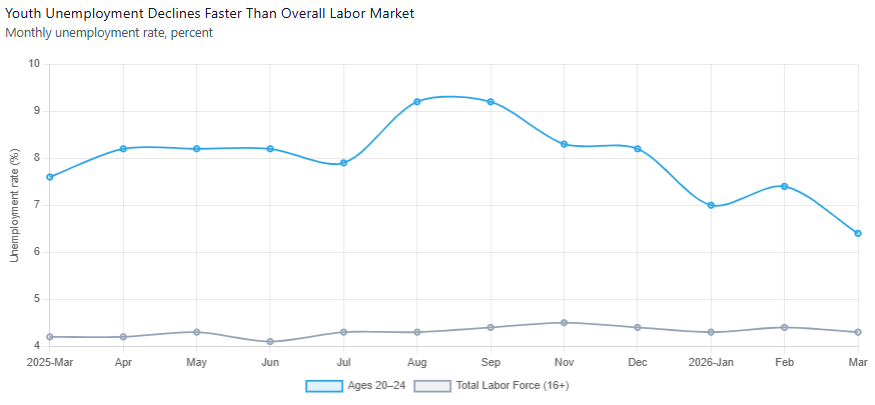
Figure 2. Unemployment rates for workers aged 20–24, compared with the total labor force (aged 16 and over).
Source: U.S. Bureau of Labor Statistics, Current Population Survey.
6. Historical Precedents Beyond Coal
Jevons’ insight has appeared repeatedly across sectors:
- Textiles: Mechanized looms reduced the cost of cloth, leading to vastly greater consumption and employment in textile manufacturing during the Industrial Revolution.
- Transportation: Fuel‑efficient vehicles lowered per-mile costs, increasing total miles driven and expanding the logistics and travel industries.
- Computing: Moore’s Law reduced the cost of computation, yet demand for software, IT services, and developers exploded rather than collapsed.
In each case, task‑level efficiency gains expanded the market faster than labor was displaced.
7. Why Professional Services Are Especially Elastic
Professional services—law, accounting, consulting, marketing—exhibit several characteristics that make them particularly susceptible to Jevons‑type effects:
- Latent demand: Many individuals and small firms forgo professional services due to cost.
- Scalability constraints: Historically, human time-limited output.
- High fixed costs: Entry requires credentials, teams, and overhead.
AI directly relaxes these constraints. Drafting contracts, preparing analyses, or building presentations becomes cheaper and faster, enabling professionals to serve clients who were previously priced out.
This expands the addressable market rather than saturating it.
8. Employment Effects: Reallocation, Not Erasure
Crucially, none of this implies that all jobs are preserved in their current form. Tasks change. Entry‑level roles focused solely on routine work may shrink. However, new roles emerge in:
- Client advisory and judgment,
- AI‑augmented oversight,
- Productized professional services,
- Entrepreneurial ventures enabled by lower costs.
From an employment perspective, the relevant question is not whether tasks disappear, but whether new combinations of tasks generate sufficient demand for labor. The evidence to date suggests they do.
9. Implications for Education
For educators, especially in entrepreneurship and business programs, the lesson is clear: the risk is not that students will be unemployable because AI does everything, but that they will be unemployable if they do not know how to work with AI.
AI literacy becomes a form of capital. Students who can:
- Decompose work into tasks,
- Delegate effectively to AI tools,
- Integrate outputs into coherent decisions,
will be able to operate at scales previously reserved for larger firms.
This is not a call to abandon foundational skills, but to teach them alongside modern tools.
10. Implications for Entrepreneurship
From an entrepreneurial standpoint, AI accelerates a long‑running trend: the unbundling and rebundling of professional services.
Lower task costs allow:
- Solo founders to launch credible firms,
- Small teams to compete with incumbents on specific services,
- New pricing models that expand access.
The result is not fewer firms, but more—consistent with Census BFS data.
11. What the Jevons Employment Effect Is—and Is Not
It is important to be precise.
The “Jevons Employment Effect” is:
- An analogy, not a direct extension of Jevons’ original work,
- A market‑level claim, not a guarantee for every individual role,
- A conditional outcome, dependent on demand elasticity and institutional adaptation.
It is not:
- A claim that AI cannot displace workers,
- A denial of transitional disruption,
- A promise of frictionless adjustment.
Economic history suggests expansion dominates in the long run, but transitions still matter.
12. Conclusion: A More Grounded Way to Talk About AI and Work
The debate over AI and employment is often framed in absolutes: utopia or dystopia, replacement or salvation. The Jevons framework offers a more sober alternative.
By lowering the cost of professional tasks, AI expands what is economically feasible. That expansion creates room for new firms, new services, and new forms of work. The empirical patterns highlighted by Apollo—rising business formation and improving youth employment—are consistent with this view.
The challenge ahead is not to stop AI, but to align education, entrepreneurship, and institutions with a world where productivity is abundant, and human judgment remains scarce.
References
- Jevons, W. S. (1866). The Coal Question. London: Macmillan.
- U.S. Bureau of Labor Statistics. Current Population Survey.
- U.S. Census Bureau. Business Formation Statistics.
- Sorrell, S. (2009). “Jevons’ Paradox revisited.” Energy Policy.
- Polimeni et al. (2008). The Myth of Resource Efficiency. Earthscan.
- Apollo Global Management (2026). The Jevons Employment Effect From AI.
-

Generative AI in Business Education, Human Dignity, and the Common Good
AI and education, assessment design, business education ethics, Catholic social teaching, common good, generative AI in business education, human dignity, professional formation, responsible AI, subsidiarity
Based on peer‑reviewed research (2023–2026)
Generative artificial intelligence is now a permanent feature of business education. The central question is no longer whether AI will be used, but whether its use will strengthen or weaken the formation of responsible professionals.
Drawing on recent peer‑reviewed research, this article examines what evidence shows about generative AI in business education and interprets those findings through the lens of Catholic Social Teaching, with particular attention to human dignity, subsidiarity, and the common good.
What the Empirical Evidence Establishes
Across experimental, survey‑based, longitudinal, and review studies, a consistent pattern emerges:
- Learning benefits appear only when assessment and task design are adjusted
- Stronger outcomes occur when student reasoning is evaluated, not just final outputs
- AI literacy operates as a cognitive skill, not a technical shortcut
- Generative AI is most effective for explanation, synthesis, and scenario exploration
- Ill‑structured business problems reshape performance distributions
Generative AI does not lower standards. It reveals whether we were ever measuring thinking in the first place.
These findings provide the empirical foundation for a moral and educational analysis.
Human Dignity and the Purpose of Learning
Catholic Social Teaching begins with the inherent dignity of the human person. Education, therefore, is not merely a process of producing outputs, but of forming rational agents capable of understanding, judgment, and responsibility.
The research shows that when generative AI replaces student reasoning, learning degrades. When AI supports explanation, critique, and synthesis, higher‑order learning improves.
This distinction matters.
It affirms that students are not interchangeable processors of information, but persons whose intellectual agency must remain central. AI serves education only when it supports, rather than substitutes for, human reasoning.
Subsidiarity: AI as Support, Not Substitution
The principle of subsidiarity holds that higher‑level systems should assist, not displace, the proper functions of persons and smaller communities.
Empirical studies consistently show that generative AI is most effective when used as a cognitive aid: reducing iteration costs, expanding exploration, and providing feedback that students actively evaluate.
When AI assumes responsibility for decision‑making or judgment, learning outcomes flatten and assessment validity collapses.
From a subsidiarity perspective, this confirms that judgment and accountability are non‑delegable.
AI should remain subordinate to human decision‑making, not elevated above it.
The Common Good and Professional Formation
Business education serves the common good by preparing graduates to act responsibly in conditions of uncertainty, time pressure, and imperfect information.
The research shows that traditional assessments often fail in generative‑AI‑enabled environments, producing performance convergence that obscures true capability.
Redesigning assessments to emphasize reasoning, justification, and accountability better aligns education with the realities of modern professional life, where AI is already embedded in decision processes.
Forming graduates who can use AI wisely, rather than defer to it uncritically, serves organizations, markets, and society as a whole.
Assessment Validity as a Moral Question
Assessment is not merely a technical exercise. It signals what an institution values and what forms of behavior it rewards.
If assessments can be completed by AI without understanding, they fail not only pedagogically, but morally: they encourage abdication of responsibility while claiming to measure competence.
The research makes clear that generative AI exposes these weaknesses.
The response is not prohibition, but reform grounded in accountability and transparency.
Ethical Alignment in an Age of Automation
Generative AI introduces opacity, delegation of reasoning, and diffused responsibility.
Business education must therefore teach:
- When AI use is appropriate
- When human judgment is non‑delegable
- How AI‑assisted decisions are documented and justified
This is not moralizing. It is professional integrity under conditions of automation.
Sources
- Pallant et al. (2025) — Shows that mastery‑oriented use of generative AI
produces higher‑order learning, while procedural use degrades outcomes,
establishing the central role of assessment design.
- Huo & Siau (2024) — Identifies opportunities and risks of GenAI in business education,
including cognitive dependency and assessment integrity challenges,
and proposes a responsible integration framework.
- Bergenholtz et al. (2025) — Demonstrates performance convergence in ill‑defined,
time‑pressured business exams, exposing assessment validity failures.
- Weng et al. (2024) — Reviews assessment approaches across 34 studies,
highlighting the shift toward career‑driven and lifelong learning outcomes.
- Hon (2025) — Systematic review documenting mixed effects of generative AI
on engagement and performance, emphasizing gaps in longitudinal evidence.
-

Generative AI in Business Education: What the Research Actually Says
AI literacy, assessment design, Business Education, business schools, educational research, Generative AI, Higher Education, learning outcomes, professional skills, responsible AI
Based on peer‑reviewed research (2023–2026)
This article examines what empirical evidence actually shows about
generative AI in business education, focusing on learning outcomes,
assessment validity, and professional capability formation.Generative AI is now embedded in business education, whether institutions planned for it or not.
What remains contested is not access to the technology, but its effect on learning.
Recurring Patterns in Generative AI in Business Education Research
Across experimental, survey‑based, longitudinal, and review studies on
generative AI in business education, several consistent patterns emerge:- Learning benefits appear only when assessment and task design are adjusted
- Stronger outcomes occur when student reasoning is evaluated, not just final outputs
- AI literacy functions as a cognitive skill, not a technical trick
- GenAI is most effective for explanation, synthesis, and scenario exploration
- Ill‑structured business problems reshape performance distributions
Generative AI does not lower standards. It reveals whether we were ever measuring thinking in the first place.
What the Empirical Evidence Shows About Generative AI in Business Education
Assessment redesign is necessary
Studies consistently show that adding generative AI to unchanged exams or assignments
does not improve learning and often weakens assessment validity.
Redesigning assessments is essential for effective generative AI use in business education.Reasoning matters more than outputs
Higher‑order learning occurs when assessments capture reasoning processes,
including explanation, critique, and justification of AI‑assisted work.AI literacy must be taught explicitly
Effective AI literacy in business education includes prompt formulation,
output evaluation, uncertainty recognition, verification, and reflection
on when not to rely on generative AI.
A Systems Lens on Generative AI in Business Education
Layer 1: Cognitive Labor Economics
Generative AI reduces the marginal cost of explanation and first‑pass analysis,
shifting educational value toward judgment, verification, and accountability.Layer 2: Learning Production Functions
Learning improves when generative AI enables iteration and critique,
and degrades when epistemic effort is bypassed.Layer 3: Assessment Validity
In generative AI–enabled business education, outputs no longer reliably signal capability
unless the reasoning process is observed.Layer 4: Professional Capability Formation
Employability increasingly depends on the ability to deliver defensible results
under time and information constraints using AI responsibly.Layer 5: Ethical and Organizational Alignment
Business education must teach when AI use is appropriate,
when judgment is non‑delegable, and how AI‑assisted decisions are justified.
Annotated Sources
- Pallant et al. (2025) — Demonstrates that mastery‑oriented GenAI use
leads to higher‑order learning, while procedural use degrades outcomes.
Establishes the central role of assessment and curriculum design.
- Huo & Siau (2024) — Identifies opportunities and risks of GenAI in business education,
including cognitive dependency and assessment integrity challenges.
Proposes a framework for responsible integration.
- Bergenholtz et al. (2025) — Shows performance convergence in ill‑defined,
time‑pressured business exams, revealing assessment validity failures in GenAI contexts.
- Blondeel et al. (2025) — Finds students use ChatGPT as a low‑pressure help‑seeking tool,
with performance benefits concentrated among lower‑GPA students.
- Bai & Wang (2025) — Shows that interaction quality and output quality
affect learning indirectly through motivation and creative self‑efficacy.
- Weng et al. (2024) — Synthesizes assessment approaches across 34 studies
and highlights the shift toward career‑driven and lifelong learning outcomes.
- Hon (2025) — Systematic review documenting mixed effects of GenAI on engagement
and performance and identifying major empirical gaps.
- Carmi (2024) — Shows learning effectiveness is driven by attitudes,
satisfaction, and accumulated experience rather than institutional training alone.
- Walke & Föller (2026) — Explores how students navigate GenAI
between academic and professional contexts, highlighting ethical tension points.
-

Why AI Delegation Fails the Moment Responsibility Matters
accountability, agent workflows, AI agents, AI delegation, AI Safety, approval workflows, audit logs, Automation, enterprise AI, escalation, governance, human in the loop, operational design, refusal, risk managementAI delegation is having a moment. Agents. Workflows. Autonomous systems. “Let the model handle it.”
In low-stakes work, it can feel like a breakthrough: tasks get handed off, tickets close, drafts appear, and follow-ups get scheduled.But there’s a consistent pattern you’ll see across teams—whether they’re discussing AI agents, prompt pipelines, or even plain old project management handoffs:
Delegation works right up until responsibility matters.
Not in the dramatic “the system went rogue” way. In a quieter, more operational way.
The task looks done. The output exists. The status is green.
And then something goes wrong and the only question that matters lands in the room:Who owned the outcome?
Most of the time, no one can answer. Or worse: three people think they didn’t.
That gap—between “work happened” and “someone owned the result”—is where AI delegation fails.
Not because intelligence is missing, but because ownership is.
The Delegation Illusion: “Task Completed” ≠ “Outcome Owned”
A lot of what we call “AI delegation” today is really just task routing:
- Send a request to a system
- Receive a plausible response
- Assume the work is complete
For reversible work, this is fine. Drafting copy. Summarizing calls. Brainstorming. Extracting bullets from a document.
If the output is mediocre, you regenerate it. If it’s wrong, you ignore it.The illusion breaks when delegation crosses a boundary into consequence:
- An email that commits the company to a promise
- A refund or pricing concession
- A customer-facing decision that can’t be cleanly reversed
- A workflow step with compliance or audit exposure
At that moment, “helpfulness” isn’t the goal. Accountability is.
And accountability is not a property of model quality.
It’s a property of system design.This is why teams often feel like they’re “so close” to automation—yet keep getting dragged back into manual review.
They’re not close to automation. They’re close to output.
Those are different.
What People Are Actually Struggling With: Blurry Boundaries
Across forums and internal team chats, the same phrases repeat:
- “It’s unclear who owns what.”
- “The AI answered, but no one owned the result.”
- “It technically did the task, but it wasn’t usable.”
Notice what’s missing from those complaints: they aren’t primarily about prompts.
They aren’t even primarily about hallucinations.
They’re about boundaries—the operational line where one party stops being responsible and another party becomes responsible.In traditional organizations, those boundaries exist even when they’re messy:
approval limits, escalation paths, job roles, who signs what, who answers to whom.In many AI deployments, those boundaries are implicit. Everyone assumes they’re “obvious.”
But they aren’t.
And the moment consequence appears, implicit boundaries become expensive.
Why People Invent Rituals Instead of Building Structure
When teams don’t trust delegation, they rarely say “we don’t trust delegation.”
They do something more subtle: they invent rituals to compensate.You’ve seen these rituals (even if you don’t call them that):
- “Ask me before you send.”
- “Wait for approval.”
- “Draft it but don’t finalize.”
- Multi-step prompt chains with manual checkpoints
- Shadow review processes where a human silently re-does the work
These are often described as safety measures. Sometimes they are.
But structurally, they’re a coping mechanism for one missing capability:
the system cannot represent responsibility clearly enough to be trusted.So humans reinsert themselves at the last second, every time.
That creates what feels like a paradox:
AI was supposed to reduce cognitive load, but now there are more steps, more exceptions, more “just in case” reviews.That is the babysitting tax—the extra supervision labor created when systems appear autonomous but are not allowed (or not designed) to own outcomes.
The tax compounds. It gets worse as volume increases.
And it produces a specific failure mode: organizations stop scaling automation right at the point where it would have been most valuable.
Where Delegation Actually Breaks: Handoffs and Irreversibility
AI delegation doesn’t fail everywhere. It fails in specific places:
at handoffs and at irreversible steps.A handoff is where work changes state:
- From internal to external
- From suggestion to decision
- From “draft” to “sent”
- From reversible to irreversible
These transitions are exactly where ownership must transfer—or be explicitly retained.
If that transfer isn’t encoded, the system keeps moving because it is optimized for completion.
And downstream humans assume someone else took responsibility.That’s how you get the familiar post-incident dialogue:
“I thought the system handled it.”
“I assumed someone approved it.”
“I didn’t realize it actually went out.”These aren’t intelligence failures. They’re delegation design failures.
If you want a practical way to think about it, ask one question about any agent workflow:
At what exact step does a human become responsible for the outcome—and how is that recorded?
If your answer is “it’s implied,” you don’t have delegation.
You have output generation with unclear liability.
The Missing Layer: Responsibility Is Not Implicit
Humans understand responsibility socially. Organizations encode it operationally.
But systems do not “pick it up” from context.A model can infer what you want. It can infer what you likely mean.
It can even infer your tone.
But it cannot absorb consequences.Systems don’t feel risk. They don’t pay for refunds. They don’t get sued.
They don’t sit in the uncomfortable meeting where a customer churned because of a careless message.So if responsibility isn’t explicit, it doesn’t vanish—it moves.
Often to the least visible person in the chain: the on-call engineer, the junior ops analyst, the support rep who inherited a mess, the PM who “owns the metric.”This is one reason AI delegation can produce silent failures:
things look fine until a consequence surfaces, and then responsibility gets assigned retroactively, socially, and inconsistently.
That’s the opposite of deployable automation.
Refusal Is Treated as Failure (and That’s Backwards)
Most AI products are trained and tuned with a single dominant incentive:
be helpful.In practice, “helpful” often becomes:
always answer, always proceed, always do something.
Refusal is treated like a defect.In operations, that incentive is backwards.
A system that cannot refuse is a system that cannot enforce boundaries.
And a system without boundaries will eventually cross one it shouldn’t.Refusal is not failure. Refusal is a control surface.
It is the system saying:- This task exceeds my authority
- This action is irreversible without approval
- This request lacks required inputs
- This outcome carries risk that must be owned by a human
A visible refusal—paired with logging and escalation—does something more important than “being safe.”
It creates clarity about responsibility.It tells the organization: “this is the boundary.”
And boundaries are what make delegation real.
What Changes When Ownership Is Explicit
When responsibility is designed into delegation, the system behaves differently—and so do humans.
Not because the AI suddenly becomes more intelligent, but because the workflow becomes more legible.A few things happen almost immediately:
- Tasks stop completing silently. Action happens only within declared authority.
- Escalations become predictable. Humans are pulled in at defined boundaries, not random moments.
- Supervision becomes targeted. Review happens where it matters (handoffs, money, customer commitments), not everywhere.
- Trust increases. Not because the system is “smarter,” but because it is constrained and auditable.
Most importantly, outcomes become inspectable.
You can answer questions like:- What was the system allowed to do?
- What did it refuse to do, and why?
- Who was notified?
- Who explicitly approved the irreversible step?
- What evidence exists for that approval?
That’s the difference between an impressive demo and an operational system.
A Practical Pattern: Treat Authority Like a Product Requirement
If you want AI delegation that holds up under consequence, treat authority as a first-class requirement.
Not an afterthought. Not a “guardrail.” A design input.That can look like:
- Explicit action types: draft vs send, suggest vs execute, queue vs publish
- Approval thresholds: amounts, risk categories, customer tiers, policy triggers
- Escalation contracts: who gets paged, who has signing authority, what context must be attached
- Audit-ready logs: what the system did, what it considered, what it refused, who approved
- Default-to-refuse at boundaries: when required ownership is absent, the system stops and asks
None of this requires futuristic AI.
It requires operational humility: recognizing that responsibility is an organizational property, and delegation only works when that property is made explicit.
Delegation Without Ownership Is a Category Error
Many teams try to solve delegation problems with better prompts, more context, or more specialized agents.
Those tools help at the margins.
But they don’t address the root failure mode.Delegation without ownership isn’t incomplete automation.
It’s a category error.You cannot delegate responsibility implicitly.
If no one is clearly accountable for the outcome, the system will fail exactly when it matters most:
at the point of money, customers, compliance, or reputation.The future of usable AI is not “more conversational.”
It’s systems that know when to act, when to stop, and when to escalate—because responsibility is visible rather than assumed.
Final Thought
AI delegation doesn’t fail because models aren’t capable.
It fails because responsibility is missing from the design.The moment responsibility matters, delegation either becomes explicit—or it breaks.
There is no stable middle ground.
-

Why Prompting Is a Tax on Operators
ai accountability, AI governance, automation limits, business automation, delegated work, human in the loop, operational ai, operational risk, process ownership, prompting tax, systems designPrompting feels harmless.
You type a request.
The system responds.
You move on.On the surface, it looks like progress.
But for operators responsible for real outcomes — revenue, compliance, follow‑through — prompting carries a hidden cost. Not in compute. Not in licensing. In attention.
And attention is the most expensive resource inside any operation.
The Illusion of Productivity
Prompt‑based AI systems are optimized to feel useful.
They answer quickly.
They speak confidently.
They adapt their tone to the user.This creates the impression that work is being done.
But in operational environments, feeling productive is not the same as finishing work.
An answer is not an outcome.
A response is not ownership.
And conversation is not execution.The moment a system requires the user to constantly re‑prompt, correct, or validate its output, the work has not been automated. It has been displaced.
The labor still exists — it has simply moved downstream to the operator.
The Hidden Cost of Prompting
Every prompt assumes supervision.
You don’t just ask once.
You read carefully.
You check for errors.
You rewrite.
You ask again.When the output is incomplete, wrong, or misaligned with context, the system does not absorb the failure.
The operator does.
This cost compounds quietly across an organization:
- Time spent reviewing instead of executing
- Cognitive load spent monitoring instead of deciding
- Responsibility without corresponding control
None of this appears on a balance sheet.
But it shows up everywhere else: slower cycles, missed follow‑ups, quiet errors, and operators who feel constantly “on call” for systems that were supposed to reduce their workload.
Prompting converts operators into editors.
Editors are not automated.
Why This Tax Persists
The prompting tax persists because its failures are subtle.
When a prompt‑based system fails, nothing explicitly breaks.
There is no alert that says, “This task was not completed.”
There is no log that shows responsibility was unclear.
There is no refusal recorded.The work simply doesn’t get finished.
And because nothing visibly fails, the burden defaults to the person closest to the outcome.
They fix it.
They remember.
They follow up.Over time, this becomes normalized.
Operators begin to expect that automation still requires babysitting. Teams quietly accept that “AI helps, but you still have to watch it.”
This isn’t a flaw in intelligence.
It’s a structural failure.
Conversation Shifts Responsibility Without Ownership
Prompt‑based systems are conversational by design.
Conversation is flexible.
Conversation is adaptive.
Conversation feels human.But conversation is also ambiguous.
In conversation, responsibility is implied, not assigned.
If something goes wrong, there is always plausible deniability:
- The prompt wasn’t specific enough
- The context wasn’t clear
- The user should have checked
In other words, the system never truly owns the outcome.
And when nobody owns the outcome, operators absorb the risk.
This is why chat‑based systems tend to break at the moment of consequence — when revenue, compliance, or real‑world follow‑through is at stake.
They were never designed to hold responsibility. Only to respond.
The Structural Alternative
Removing the prompting tax does not require more capable AI.
It requires structure.
Specifically:
- A clearly defined task
- Explicit boundaries on what the system may and may not do
- Clear refusal conditions when judgment is required
- Logged escalation paths when the task cannot be completed
Structure changes the failure mode.
Instead of failing quietly, the system fails visibly.
Instead of shifting responsibility downstream, it explicitly escalates responsibility.
This makes failure cheaper.
Loud failure is actionable.
Silent supervision is not.
What Changes When the Tax Is Removed
When prompting is no longer required, several things happen immediately:
- Operators stop supervising conversations
- Systems either complete tasks or escalate clearly
- Responsibility becomes legible
- Mistakes become traceable instead of absorbable
The work either moves forward — or it stops visibly.
Both outcomes are preferable to the illusion of progress.
Most importantly, operators regain attention.
They are no longer monitoring AI.
They are managing systems.
The Operator Reality
Operators do not need more articulate answers.
They need finished work.
Any system that requires constant prompting has already shifted cost downstream — whether it admits it or not.
Prompting feels neutral.
It is not.It is a tax on attention, judgment, and responsibility.
And like all taxes, it compounds.
The question is not whether AI can talk better.
The question is whether systems can own outcomes.
Until they do, operators will keep paying the difference.
Prompting isn’t automation.
It’s a tax.
Published by Almma.AI — focused on delegated work that finishes, refuses clearly, and escalates responsibly.
-
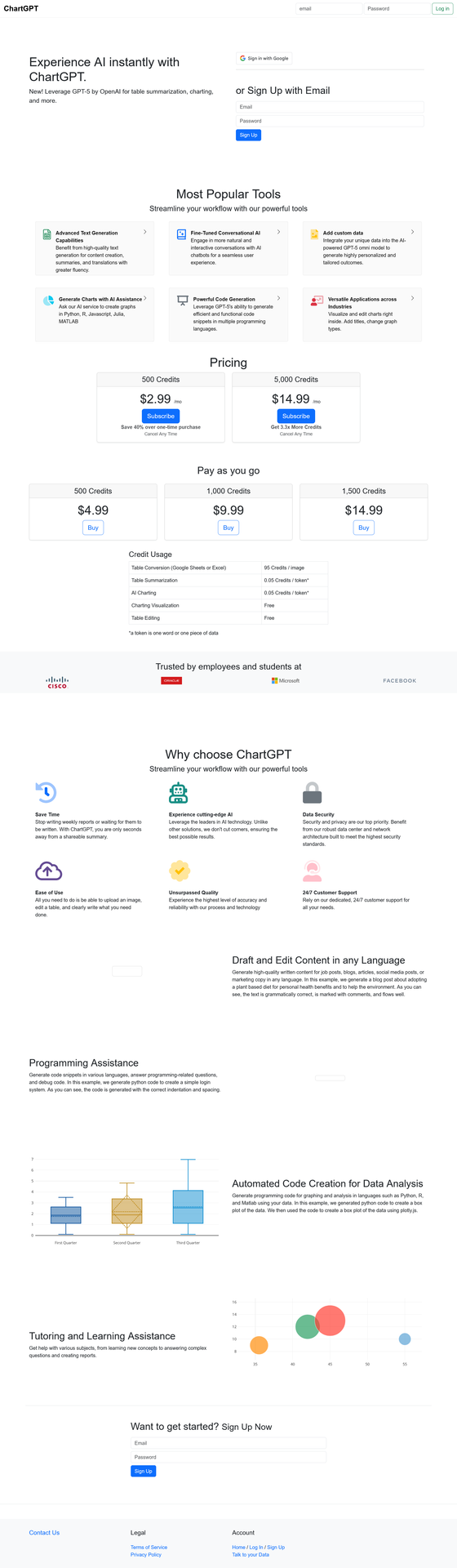
Chart GPT: Free AI Tool for Data Visualization & Chart Generation
ai charts, ai data visualization, ai graph maker, chart generator free, chart gpt, chartgpt, data visualization tool, free chart generator, gpt charts, visualization aiChart GPT turns your data into stunning visualizations instantly — no coding required.
This free AI tool uses advanced technology to create charts, graphs, and data visualizations from simple text prompts. Whether you’re a business analyst, student, or researcher, this powerful assistant transforms complex data into clear visual insights in seconds. Explore this and other AI assistants on Almma.
What is Chart GPT?
Chart GPT is an AI-powered assistant that generates charts, graphs, and data visualizations through natural language conversation. Instead of wrestling with Excel formulas or learning complex visualization software, you simply describe what you want — and the tool creates it.
Built on advanced GPT technology with integrated DALL-E image generation and web browsing capabilities, Chart GPT has facilitated over 200,000 conversations, helping users visualize their data effortlessly.
Key capabilities:
- Generate bar charts, line graphs, pie charts, scatter plots, and more
- Analyze uploaded spreadsheets and CSV files
- Browse the web to gather real-time data for visualization
- Create presentation-ready graphics with DALL-E integration
- Export visualizations in multiple formats
Who Uses Chart GPT?
Business Professionals
Create quarterly reports, sales dashboards, and executive presentations without waiting for your data team. This AI assistant turns raw numbers into boardroom-ready visuals in minutes.
Students & Researchers
Visualize research data, create thesis graphics, and build compelling presentations. The tool supports academic workflows with accurate, publication-quality charts.
Content Creators & Marketers
Transform statistics into shareable infographics for social media, blog posts, and marketing materials. Make data storytelling accessible to your audience.
Data Analysts
Prototype visualizations quickly before building production dashboards. Use Chart GPT for rapid exploration and stakeholder communication.
Chart GPT Features
Feature Description Natural Language Input Describe your chart in plain English — no formulas or code needed File Upload Support Upload CSV, Excel, or text files for instant analysis Web Browsing Pull real-time data from the web to create up-to-date visualizations DALL-E Integration Generate custom graphics and enhanced visual elements Multiple Chart Types Bar, line, pie, scatter, histogram, area charts, and more Code Generation Get Python, R, JavaScript, Julia, or MATLAB code for your visualizations
How to Use The Tool
Step 1: Describe Your Data
Describe what data you want to visualize. You can type it directly, upload a file, or ask it to research data online.
Example prompt: “Create a bar chart showing the top 10 countries by GDP in 2024.”
Step 2: Refine Your Visualization
The assistant generates an initial visualization. Ask for adjustments — change colors, add labels, switch chart types, or modify the data range.
Example prompt: “Make it a horizontal bar chart with blue bars and add the exact GDP values as labels.”
Step 3: Export and Use
Download your finished chart or copy the generated code to use in your own projects. Charts are ready for presentations, reports, or web publishing.
Chart GPT vs. Alternatives
Feature Chart GPT Traditional Tools
(Excel, Tableau)Other AI Tools Learning Curve None — use natural language Steep — requires training Varies Speed Seconds Minutes to hours Seconds Cost Free $0–$70+/month $10–$30/month Web Data Access ✅ Yes ❌ Manual import Limited Code Export ✅ Python, R, JS, Julia, MATLAB ❌ No Limited File Upload ✅ Yes ✅ Yes Varies
Real-World Use Cases
Sales Report Automation
“I upload my monthly sales CSV and ask Chart GPT to create a comparison chart against last quarter. What used to take me 2 hours now takes 2 minutes.”Academic Research
“For my thesis, I needed to visualize survey data across multiple demographics. Chart GPT generated publication-ready figures and gave me the Python code to reproduce them.”Marketing Presentations
“Our marketing team uses this AI visualization tool to turn campaign metrics into visuals for client presentations. The DALL-E integration helps us create branded graphics that match our style guide.”
Frequently Asked Questions
Is Chart GPT free to use?
Yes. Chart GPT is available at no cost through Almma. You can start creating visualizations immediately without a subscription or credit card.
What file formats does it support?
Chart GPT accepts CSV files, Excel (.xlsx, .xls) spreadsheets, and plain-text data. You can also paste data directly into the conversation.
Does it access live data from the internet?
Yes. Chart GPT includes web-browsing capabilities, enabling it to research and pull up-to-date data from online sources to create visualizations.
What programming languages can it generate code for?
Chart GPT can output visualization code in Python (matplotlib, seaborn, plotly), R (ggplot2), JavaScript (D3.js, Chart.js), Julia, and MATLAB.
How accurate are its visualizations?
ChartGPT generates visualizations based on the data you provide or data it retrieves from the web. Always verify critical data points, especially for business or academic use.
Can I use the visualizations commercially?
Yes. Visualizations you create with Chart GPT can be used in commercial presentations, reports, and publications.
Get Started with Chart GPT
Stop struggling with spreadsheet formulas and complex visualization software. Chart GPT makes data visualization accessible to everyone.
200,000+ conversations | Free to use | No signup required
-

How AlmmaGPT System Prompts Work (And Why They’re Different)
AI empowerment, AI ethics, AI governance, AI movement, AI trust, AlmmaGPT, anti-hallucination principle, dignity principle, ethical AI tools, generative AI safety, responsible AI, transparent AI1. Opening: Why System Prompts Matter
Most people using AI never see the rules that guide its responses. They type a question or task, an answer comes back — and that’s it. But behind every output is a foundation: a set of instructions that determines tone, accuracy, and behavior.
In many AI systems, these “hidden rules” are optimized for speed, engagement, or performance scores, often without the user knowing what trade-offs were made. AlmmaGPT takes a very different approach — one built on the belief that the rules should serve people first.
At AlmmaGPT, this foundation is intentional. It isn’t just about style, efficiency, or competitive advantage. Our default instructions (system prompts) are designed around human dignity, truthfulness, and empowerment. They are not suggestions; they are enforced standards.
2. What Is a System Prompt? (Without the Tech Overload)
Think of a system prompt as the “constitution” of an AI — a permanent instruction layer that shapes every answer. It doesn’t matter if you’re asking about a market trend, writing a story, or doing research; these rules always apply.
Where a single law governs only part of society, a constitution sets the overarching principles for every decision. That’s a good way to imagine AlmmaGPT’s system prompt: a permanent, values-driven framework.
Another analogy is “guardrails vs. steering wheel.” You can turn the wheel in many directions, but the guardrails keep you from going off course entirely. The system prompt is the set of guardrails — protection against harmful or misleading behavior.
Or think of it as ethical DNA: while the AI’s words may change with every answer, its underlying values stay constant.
3. Almma’s Philosophy: Why These Rules Exist
Almma was built on the idea that AI should expand human agency, not erode it. That means decisions should be informed, respectful, and transparent. We believe accuracy and dignity aren’t “nice-to-have” — they are essential for empowerment.
In the broader AI industry, models can sometimes prioritize sounding confident over being correct, especially when uncertainty is present. AlmmaGPT rejects that path. Our philosophy demands that users deserve to know when the AI is unsure, and that it must avoid presenting guesswork as fact.
These rules connect directly to Almma’s movement:
- AI Profits for All → Tools that lift people up rather than serve only a few
- Democratization → Open, fair access to advanced AI
- Fairness → Equal respect and truthful outputs regardless of user background
- Trust as Infrastructure → Reliability as the base layer for innovation
This philosophy is not just branding. It’s operational — embedded in the AI’s core behavior.
4. The Two Non‑Negotiable Principles
4.1 Dignity Principle by Almma
Every response from AlmmaGPT is bound by the Dignity Principle by Almma. This means that respect for the individual — whether directly addressed or indirectly affected — is non‑negotiable. Outputs must never demean, manipulate, or exploit.
In practice, this leads to:
- A more respectful tone, even in disagreement
- Thoughtful handling of sensitive topics
- Safer use in education, work, and family contexts
The result? AI that can be integrated into diverse human environments without undermining the humanity of its users.
4.2 Anti-Hallucination Principle by Almma
Equally important is the Anti-Hallucination Principle by Almma. AlmmaGPT is instructed not to fabricate information. When certainty isn’t possible, it will say so — clearly.
If an estimate must be made, it will explain how the estimate was formed. This encourages clarity and allows the user to judge whether the reasoning fits their needs.
The benefits for you:
- Fewer false positives
- Less silent misinformation
- More informed decision-making
“Not knowing — and admitting it — is a feature, not a flaw.”
5. What This Means for You as a User
These principles directly shape your experience with AlmmaGPT.
You might notice instances where:
- The AI’s answer is more cautious than others you’ve seen — this is intentional.
- AlmmaGPT asks clarifying questions before giving an answer — to ensure accuracy.
- Certain requests are reframed or declined — because they could break trust or dignity.
Examples:
- Research: Citations for claims, transparency about uncertainty.
- Business Planning: Market estimates with clear methodology.
- Content Creation: Avoiding offensive or false narratives without sacrificing creativity.
- Education: Clarifying ideas instead of confidently presenting incorrect ones.
Rather than limiting you, these behaviors protect you. AI built for quick impressiveness can wow in the short term, but erode trust in the long run. AlmmaGPT chooses lasting reliability.
6. Transparency Without Exposure: What We Share and What We Don’t
We believe in openness — but responsible openness. Almma shares its principles publicly so users understand the AI’s ethical boundaries. However, we don’t publish every line of internal mechanics.
This prevents misuse, maintains security, and stops bad actors from circumventing safeguards. You can rely on the outcomes this system produces without needing to reverse-engineer the framework.
It’s about:
- Being transparent where it matters
- Setting boundaries where it’s responsible
7. Closing: Building AI That Serves People, Not the Other Way Around
AlmmaGPT’s system prompts aren’t hidden magic — they are the conscious design choices that make it different. They ensure that human dignity and truth are the first priorities, not afterthoughts.
As you work with AlmmaGPT, you’re not just using an AI — you’re engaging with values that refuse to compromise. And that’s exactly how we believe technology should serve humanity.
“The future of AI isn’t just about what it can do — it’s about what it refuses to do.”
We invite you to use AlmmaGPT consciously, to build with trust, and to demand that AI reflects the standards you deserve.
-

Why AI Without Ownership Fails the People Who Power It
AI access, AI economy, AI infrastructure, AI ownership, AI participation, Almma, Artificial Intelligence, digital economy, Ethical AI, future of work, technology ethicsArtificial intelligence is reshaping economies, organizations, and daily life at an unprecedented pace. Productivity gains are accelerating. Systems are scaling. New forms of value are being created.
And yet, beneath the momentum, a structural problem is quietly taking shape.
AI is being built primarily for efficiency and scale, not for participation.
Historically, major technological shifts have produced tension before equilibrium. The industrial revolutions of the past displaced labor but eventually created new forms of access: ownership stakes, wage growth, entrepreneurship, and participation in the upside of progress. These mechanisms were imperfect and uneven, but they existed.
What makes artificial intelligence different is not its power, but its structure.
AI systems increasingly produce value without clear pathways for the people who contribute data, insight, labor, and context to participate in that value. Contribution and ownership have become disconnected.
This is not a failure of innovation. It is a failure of design.
When access to ownership is restricted—whether intentionally or by omission—technology becomes extractive rather than elevating. Progress accelerates, but trust erodes. Wealth concentrates, while participation narrows. Over time, this imbalance weakens not only economic outcomes but also social legitimacy.
At Almma, we begin from a simple premise:
People who help power intelligent systems should not be excluded from the benefits those systems generate.
This is not an ideological position. It is a practical one.
Sustainable technological progress depends on broad‑based participation. Markets function best when incentives are aligned. Innovation lasts when dignity, agency, and opportunity are preserved.
AI does not need to be feared. But it does need to be structured responsibly.
Access, ownership, and ethical participation are not secondary considerations to be addressed later. They are foundational requirements that determine whether artificial intelligence becomes a force for shared prosperity or a source of concentrated advantage.
The future of AI will not be defined solely by what systems can do.
It will be defined by who gets to participate in what they produce.
At Almma, we are committed to building infrastructure that respects this reality—quietly, deliberately, and with the long term in mind.

You must be logged in to post a comment.