

Why Cheaper Professional Work Expands Markets, Firms, and Jobs
Lucas Wall
April 2026
Abstract
Recent commentary from Apollo Global Management argues that artificial intelligence (AI), by lowering the cost of professional tasks, is expanding employment rather than destroying it. Apollo labels this phenomenon the “Jevons Employment Effect,” drawing an analogy to the nineteenth‑century observation by William Stanley Jevons that improvements in fuel efficiency increased, rather than reduced, coal consumption. This article evaluates that claim rigorously. It revisits Jevons’ original argument, distinguishes it from the modern rebound effect, maps Apollo’s charts to authoritative public datasets, and situates AI‑enabled professional services within a longer economic history of cost‑driven market expansion. The evidence suggests that AI is best understood not as a labor‑replacing technology in aggregate, but as a task‑cost‑reducing general‑purpose technology that expands addressable markets, lowers barriers to firm formation, and reallocates labor toward higher‑value activities. The implications for education and entrepreneurship are profound: the central risk is not technological unemployment, but institutional failure to prepare workers to operate productively in AI‑augmented markets.
1. Introduction: Why This Debate Matters
Few claims provoke as much anxiety as the assertion that “AI will take jobs.” The concern is understandable. Large language models can now draft contracts, prepare financial analyses, summarize regulations, generate marketing content, and write software—activities historically performed by highly educated professionals.
Yet economic history cautions against linear extrapolation from task automation to employment collapse. Time and again, technologies that sharply reduce the cost of performing certain tasks have expanded total output, increased firm entry, and ultimately raised employment in the affected sectors.
Apollo’s April 2026 Daily Spark proposes that AI belongs to this latter category. The firm argues that cheaper professional work is expanding demand faster than automation can displace labor, especially among younger workers and new firms. This article examines whether that claim is theoretically sound and empirically defensible.
2. Jevons’ Original Insight: What Was Actually Claimed
The starting point is William Stanley Jevons’ The Coal Question (1866). Jevons was not writing about employment, nor about technology optimism. He was concerned with Britain’s long‑term economic sustainability given its reliance on coal.
In a now‑canonical passage, Jevons wrote:
“It is wholly a confusion of ideas to suppose that the economical use of fuel is equivalent to a diminished consumption. The very contrary is the truth.”
Jevons observed that James Watt’s improvements to the steam engine dramatically increased fuel efficiency. Yet Britain’s coal consumption rose sharply afterward. The reason was not wastefulness, but economics: cheaper steam power enabled new industries, expanded transportation, and increased production across the economy.
Several clarifications matter:
- Jevons was making an empirical observation, not a moral claim.
- The unit of analysis was total consumption, not per‑unit efficiency.
- The mechanism was market expansion, driven by lower effective prices.
What later became known as Jevons’ Paradox is therefore a statement about system‑level outcomes, not individual behavior.
3. From Jevons to the Rebound Effect
Modern economics generalizes Jevons’ insight through the concept of the rebound effect. When efficiency improvements lower the cost of using a resource, demand for that resource may increase.
Economists typically distinguish:
- Direct rebound (using more of the same good),
- Indirect rebound (spending savings on other goods), and
- Economy‑wide rebound (general equilibrium effects).
Unlike Jevons’ original observation, rebound effects are often partial. In some cases, efficiency gains still reduce total consumption. In others, they fully offset savings (“backfire”).
The key point is that efficiency does not map mechanically to contraction. Outcomes depend on demand elasticity, substitution effects, and market structure.
4. Extending the Logic to Labor: Is This Legitimate?
Apollo’s argument implicitly extends this logic from energy to professional labor. The claim is not that AI consumes labor, but that it reduces the cost of performing professional tasks, such as drafting, analysis, or documentation.
This distinction matters. AI does not eliminate the need for legal services, accounting, or consulting. Instead, it changes the production function of those services by lowering the cost of certain inputs.
If demand for professional services is elastic—and historical evidence suggests it often is—then lower prices should increase quantity demanded. That expansion can support more firms and more workers, even if the composition of work changes.
This is not a radical claim. It is standard microeconomics applied to services rather than goods.
5. Mapping Apollo’s Evidence to Public Data
Apollo cites three empirical patterns:
- Exploding business formation, and
- Declining unemployment among young workers,
- A conceptual model showing falling task costs alongside rising total professional output.
5.1 Business Formation
Apollo’s business‑formation chart aligns with the U.S. Census Bureau’s Business Formation Statistics (BFS), which track weekly business applications.
Since 2020, weekly applications have remained structurally higher than pre‑pandemic levels. While multiple factors contribute—remote work, regulatory changes, and pandemic‑era disruptions—AI plausibly lowers the fixed costs of starting service firms by reducing the need for large support staffs.
The Census data alone do not prove causality, but they are consistent with a story of falling barriers to entry.

Source: U.S. Census Bureau, Business Formation Statistics (HBA_BSA).
5.2 Youth Unemployment
Apollo’s chart draws on the U.S. Bureau of Labor Statistics’ Current Population Survey. The relevant series are:
- Unemployment rate, ages 16 and over (LNS14000000),
- Unemployment rate, ages 20–24 (BLS CPS age‑cohort series).
Publicly available BLS tables confirm that unemployment among workers aged 20–24 has declined more sharply post‑pandemic than the overall labor force. This pattern is inconsistent with a narrative of widespread entry‑level displacement due to AI.
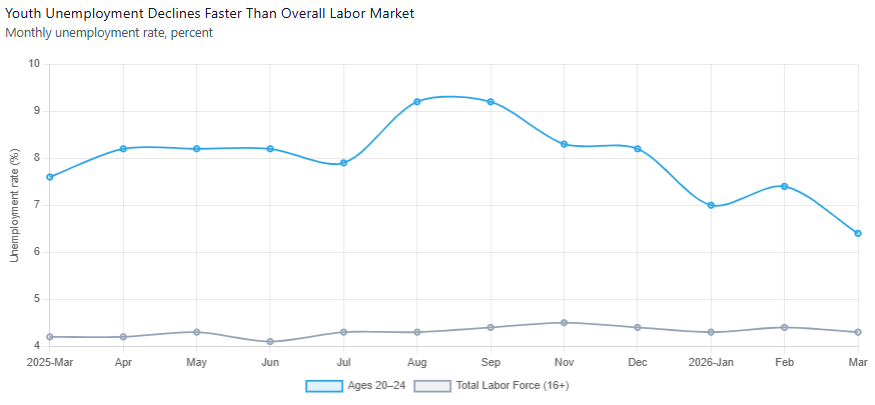
Source: U.S. Bureau of Labor Statistics, Current Population Survey.
6. Historical Precedents Beyond Coal
Jevons’ insight has appeared repeatedly across sectors:
- Textiles: Mechanized looms reduced the cost of cloth, leading to vastly greater consumption and employment in textile manufacturing during the Industrial Revolution.
- Transportation: Fuel‑efficient vehicles lowered per-mile costs, increasing total miles driven and expanding the logistics and travel industries.
- Computing: Moore’s Law reduced the cost of computation, yet demand for software, IT services, and developers exploded rather than collapsed.
In each case, task‑level efficiency gains expanded the market faster than labor was displaced.
7. Why Professional Services Are Especially Elastic
Professional services—law, accounting, consulting, marketing—exhibit several characteristics that make them particularly susceptible to Jevons‑type effects:
- Latent demand: Many individuals and small firms forgo professional services due to cost.
- Scalability constraints: Historically, human time-limited output.
- High fixed costs: Entry requires credentials, teams, and overhead.
AI directly relaxes these constraints. Drafting contracts, preparing analyses, or building presentations becomes cheaper and faster, enabling professionals to serve clients who were previously priced out.
This expands the addressable market rather than saturating it.
8. Employment Effects: Reallocation, Not Erasure
Crucially, none of this implies that all jobs are preserved in their current form. Tasks change. Entry‑level roles focused solely on routine work may shrink. However, new roles emerge in:
- Client advisory and judgment,
- AI‑augmented oversight,
- Productized professional services,
- Entrepreneurial ventures enabled by lower costs.
From an employment perspective, the relevant question is not whether tasks disappear, but whether new combinations of tasks generate sufficient demand for labor. The evidence to date suggests they do.
9. Implications for Education
For educators, especially in entrepreneurship and business programs, the lesson is clear: the risk is not that students will be unemployable because AI does everything, but that they will be unemployable if they do not know how to work with AI.
AI literacy becomes a form of capital. Students who can:
- Decompose work into tasks,
- Delegate effectively to AI tools,
- Integrate outputs into coherent decisions,
will be able to operate at scales previously reserved for larger firms.
This is not a call to abandon foundational skills, but to teach them alongside modern tools.
10. Implications for Entrepreneurship
From an entrepreneurial standpoint, AI accelerates a long‑running trend: the unbundling and rebundling of professional services.
Lower task costs allow:
- Solo founders to launch credible firms,
- Small teams to compete with incumbents on specific services,
- New pricing models that expand access.
The result is not fewer firms, but more—consistent with Census BFS data.
11. What the Jevons Employment Effect Is—and Is Not
It is important to be precise.
The “Jevons Employment Effect” is:
- An analogy, not a direct extension of Jevons’ original work,
- A market‑level claim, not a guarantee for every individual role,
- A conditional outcome, dependent on demand elasticity and institutional adaptation.
It is not:
- A claim that AI cannot displace workers,
- A denial of transitional disruption,
- A promise of frictionless adjustment.
Economic history suggests expansion dominates in the long run, but transitions still matter.
12. Conclusion: A More Grounded Way to Talk About AI and Work
The debate over AI and employment is often framed in absolutes: utopia or dystopia, replacement or salvation. The Jevons framework offers a more sober alternative.
By lowering the cost of professional tasks, AI expands what is economically feasible. That expansion creates room for new firms, new services, and new forms of work. The empirical patterns highlighted by Apollo—rising business formation and improving youth employment—are consistent with this view.
The challenge ahead is not to stop AI, but to align education, entrepreneurship, and institutions with a world where productivity is abundant, and human judgment remains scarce.
References
- Jevons, W. S. (1866). The Coal Question. London: Macmillan.
- U.S. Bureau of Labor Statistics. Current Population Survey.
- U.S. Census Bureau. Business Formation Statistics.
- Sorrell, S. (2009). “Jevons’ Paradox revisited.” Energy Policy.
- Polimeni et al. (2008). The Myth of Resource Efficiency. Earthscan.
- Apollo Global Management (2026). The Jevons Employment Effect From AI.
Leave a Reply