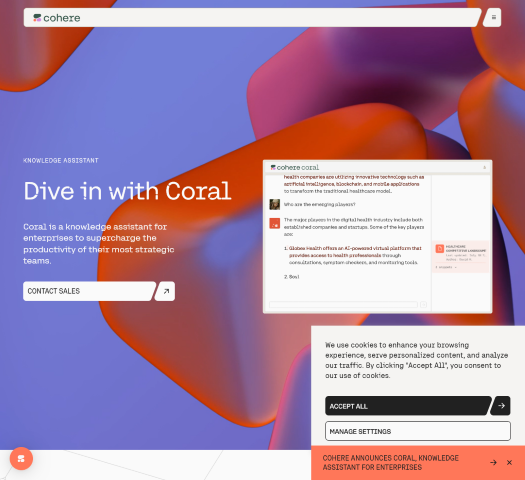

In its July 25, 2023 announcement, Cohere introduced Coral as a knowledge assistant for enterprises designed to improve the productivity of strategic teams. Coral is described as an enterprise chatbot that converses with users to help them complete business tasks, powered by Cohere’s Command model (trained with chat, reasoning, and writing abilities) and customized by augmenting its knowledge base through data connections. Cohere also emphasizes private deployment so that sensitive data and outputs do not leave a company’s data perimeter, and highlights grounding with citations to help users verify responses.
This article unpacks what Cohere is claiming with Coral, why those product choices matter in real enterprises, and how teams can evaluate a “knowledge assistant” without falling into the twin traps of chatbot hype and chatbot fear.
Primary source:
Cohere — “Introducing Coral, the Knowledge Assistant for Enterprises” (Jul 25, 2023).
Additional studies cited by Cohere in the post include McKinsey (time spent searching for information) and an NBER study (customer support outcomes). Where those studies are mentioned below, they are attributed as described in the Cohere post.
The enterprise reality: information overload is now a productivity problem
Cohere’s framing starts with a simple observation: as work environments evolved, employees increasingly want to ask questions in natural language and get relevant answers—like they would from a colleague. That expectation makes sense. The best “search” experience inside a company is often still a human: ask the person who’s been here longer, the person who built the system, or the person who “just knows.”
But this human-search approach doesn’t scale. It creates bottlenecks around experts and managers, and it silently taxes the rest of the organization with time loss and context switching. Cohere points to a McKinsey report, stating employees can spend up to 20% of their day searching for information. Whether the number lands at 10%, 20%, or higher in your specific environment, the directional claim is hard to dispute: modern digital work produces more knowledge artifacts than any one person can keep indexed in their head.
This is the pain point Coral is meant to address: not “AI for novelty,” but an enterprise-grade assistant that helps people do their jobs faster by making organizational knowledge usable on demand.
What Cohere says Coral is (and what that implies technically)
In the announcement, Cohere describes Coral as an enterprise chatbot that helps users complete business tasks. It is:
- Powered by Command: Coral uses Cohere’s Command model, trained with chat, reasoning, and writing abilities.
- Customized via knowledge augmentation: It is customized for companies by augmenting its knowledge base with data connections.
- Privately deployed: It is deployed privately to protect sensitive data; Cohere states the data used for prompting and the chatbot’s outputs will not leave the company’s data perimeter, and that Cohere is cloud-agnostic, supporting deployment on any cloud.
- Grounded with citations: Coral can produce responses with citations from relevant data sources; Cohere states the models are trained to seek relevant data based on a user’s need, including from multiple sources.
- Integration-rich: Cohere states Coral has 100+ integrations ready to connect to data sources across CRMs, collaboration tools, databases, search engines, support systems, and more.
Those elements—model capability, retrieval/augmentation, grounding/citations, integrations, and private deployment—add up to a specific view of what an enterprise chatbot must become to be safe and useful: a controlled interface to enterprise knowledge, not merely a generative text box.
“Redefining productivity”: why early chatbot gains don’t automatically translate to enterprise value
Cohere notes that consumer chatbots have shown early evidence of improved productivity, citing research studies indicating that the time it takes for brainstorming and drafting communications can improve by up to 50%.
That claim resonates with many teams: a good model can turn a blank page into a draft quickly, generate alternatives, and accelerate editing.
However, brainstorming and drafting are only part of enterprise work. In many functions, the expensive part isn’t writing—it’s verifying. It’s ensuring the response is aligned with current policy, contract terms, product reality, and regulated constraints. In short: enterprises don’t just need fluent text; they need correct and auditable outputs.
Cohere’s announcement makes that pivot explicit: Coral is positioned as a “knowledge assistant” rather than a generic chatbot, and the features they emphasize—grounding with citations, data connections, and private deployment—are a direct response to where consumer chatbots break down in enterprise contexts.
Who benefits: knowledge workers and customer support (with concrete scenarios)
The Cohere post outlines demand for knowledge assistants across business functions, but it calls out two groups in particular: knowledge workers and customer support.
The difference matters because “chatbot ROI” looks different depending on the workflow.
1) Knowledge workers: research, analysis, recommendations—faster and in one thread
Cohere lists knowledge workers such as account executives, analysts, consultants, engineers, lawyers, emphasizing that while tasks differ by role, they share a core loop: research, analyze, and recommend. Coral is described as conversational, able to remember history, and capable of researching, drafting, summarizing, and more.
Cohere provides a concrete example: a financial analyst can ask for an overview of a new market, identify major players, and generate a financial overview within the same conversation.
That example is more important than it looks. It implies multi-step task support—where the assistant retains context across turns instead of treating each prompt like an isolated query.
In practice, that kind of conversation could resemble:
- User: “Give me an overview of the market for X in region Y.”
- Assistant: A structured summary, grounded in internal research notes and approved external sources (depending on configuration).
- User: “Who are the major players, and what are their differentiators?”
- Assistant: A ranked list with supporting citations.
- User: “Draft a one-page financial overview for our leadership team.”
- Assistant: A draft memo using the conversation’s context and pulled facts, with citations for the key claims.
Even when this doesn’t eliminate human judgment, it can compress a workflow from hours to minutes—especially the “first draft” and “first cut of research” phases that tend to dominate.
2) Customer support: faster resolution with a grounded internal assistant
Cohere argues that customer support departments need product information quickly and accurately, and that an internal chatbot with product and support details can resolve cases faster. The post cites an NBER study finding that customer support agents with access to such an assistant resolve 14% more cases on average, with additional benefits like improved customer sentiment, fewer requests for managerial intervention, and improved employee retention.
For support, “knowledge assistant” success often hinges on two things:
- Retrieval quality: the assistant must surface the right troubleshooting steps, policy constraints, and product facts.
- Response governance: the assistant must avoid making up steps that aren’t in the runbook, and it must make it easy for agents to verify with citations.
In other words, the best support assistant isn’t the one that writes the prettiest answer. It’s the one that reduces guesswork while staying anchored to what your organization actually knows.
The adoption barrier Cohere centers: privacy risk and trust (hallucinations)
A striking part of Cohere’s announcement is how directly it addresses the reasons enterprises hesitate: data privacy and trust.
Cohere notes that many companies have banned consumer chatbots because of the risk that sensitive data could be leaked outside the company, especially when tools require sending data to an external managed service.
This is not just theoretical fear. In most enterprises, a single accidental paste—customer data, legal terms, product roadmap—can trigger real consequences. The result is that employees either avoid AI tools altogether or use them “off the books,” which is worse because it removes governance and security oversight.
Cohere also addresses hallucinations: LLMs can sound confident, and a confident hallucination can lead to serious misunderstandings. Business users want the ability to verify responses.
Coral’s grounding and citations are positioned as a practical answer to that demand.
This emphasis aligns with a basic enterprise truth: for tools that influence decisions, trust is a feature—and trust is built through verifiability, controlled data flows, and predictable behavior, not marketing language.
The four pillars Cohere highlights: Conversational, Customized, Grounded, Private
The Cohere post organizes Coral around four characteristics. Each one maps to a real enterprise requirement.
Conversational: chat as the interface, with memory of history
Cohere describes Coral as conversational: it understands intent, remembers conversation history, and is simple to use. This matters because many enterprise tasks are not one-shot questions. They are sequences:
clarify the request, gather context, retrieve relevant information, draft an output, revise, and format for the destination (email, memo, ticket, internal doc).
“Remembering the history” reduces repetitive context dumping and helps the assistant behave more like a collaborator than a search bar.
Customized: your business nuance via data connections and integrations
Cohere’s key point is blunt: out-of-the-box chatbots don’t know your business. The details that matter—industry terminology, product naming, internal policy, customer commitments—are precisely the details generic models don’t have.
Coral is described as customizable by augmenting its knowledge base through data connections, and Cohere claims 100+ integrations across CRMs, collaboration tools, databases, search engines, support systems, and more.
The practical implication: value will depend less on how impressive the base model feels in a demo, and more on how well Coral can connect to the systems where your truth actually lives.
In many organizations, that’s a messy set of sources, and integration breadth can reduce time-to-value.
Grounded: citations and multi-source retrieval to support verification
Cohere emphasizes grounding as a way to help verify generations. Coral can produce responses with citations from relevant data sources. The announcement also states that Cohere’s models are trained to seek relevant data based on a user’s need, even across multiple sources.
From an operational standpoint, citations do two jobs:
- They reduce risk: users can check whether a claim is supported by a trusted source.
- They build adoption: users trust tools they can audit quickly.
This is especially important when a response could influence external communication (customer emails, proposals, legal language) or internal decisions (pricing exceptions, compliance steps).
Private: keep sensitive prompts and outputs inside the company perimeter
The Cohere post frames private deployment as essential for enterprises that want business-grade chatbots aligned with safe, secure principles. Cohere states that the data used for prompting and the chatbot outputs will not leave a company’s data perimeter. It also states Cohere is cloud-agnostic and supports deployment on any cloud.
For many buyers, this will be the decisive category differentiator: not whether the chatbot can write, but whether it can be deployed in a way that satisfies security, compliance, and procurement requirements.
What partner quotes suggest about Coral’s ecosystem direction
The announcement includes statements from Oracle Cloud Infrastructure, LivePerson, and Elastic. While partner quotes are inherently promotional, they still provide signals about intended enterprise positioning:
- Oracle Cloud Infrastructure (Greg Pavlik): emphasizes accelerating AI initiatives with “knowledge augmentation capabilities,” and providing generative AI-based features that use an organization’s own data to improve decision-making and customer experiences.
- LivePerson (Joe Bradley): emphasizes delivering custom LLMs for customer engagement based on enterprise needs, goals, policies, and data, and highlights that Coral’s knowledge augmentation connects to additional data sources to keep conversations grounded and factual in real-life use cases.
- Elastic (Matt Riley): emphasizes pairing Elasticsearch with Coral to leverage structured and unstructured data to increase employee efficiency, referencing “Elasticsearch AI” coupled with Coral.
The consistent theme across these quotes matches the main product pillars: data connectivity + grounding + enterprise deployment.
In other words, Coral isn’t pitched as “a chatbot that knows everything,” but as an assistant that knows your enterprise knowledge—safely—inside the tooling ecosystem enterprises already run.
How to evaluate Coral in a pilot: questions that protect you from demo-driven decisions
Cohere states Coral is in private access with a select group of customers and directs interested companies to contact the team (via cohere.com/coral-contact, as referenced in the post).
If you are evaluating Coral (or a comparable enterprise knowledge assistant), a pilot should be designed to surface the real failure modes early—before broad rollout.
1) Pick one strategic workflow and define “done”
“Improve productivity” is not a pilot objective; it’s an aspiration. A workable objective sounds like:
“Reduce time to produce a first-draft customer response for Tier-2 tickets,” or
“Cut time spent finding policy answers for onboarding managers.”
2) Test grounding under pressure
Ask questions where the answer is easy to get wrong:
exceptions, edge cases, outdated policy pages, conflicting documentation.
Then evaluate whether the assistant:
(a) provides citations,
(b) asks clarifying questions when needed,
and (c) avoids inventing details.
3) Validate the privacy story with your security team
Since Cohere emphasizes private deployment and that prompts/outputs do not leave the data perimeter, your security review should translate those claims into concrete controls: identity and access management, network boundaries, logging, retention, and governance.
(The Cohere post describes the principles; your deployment architecture will determine how they’re achieved in your environment.)
4) Measure outcomes that matter to the role
For knowledge workers: minutes saved per research task, fewer context-switches, faster drafting cycles.
For customer support: cases resolved per agent, time-to-resolution, and reduced escalations.
Cohere references an NBER study about a 14% improvement in cases resolved; even if your number differs, you can still measure directionally similar outcomes.
One unusually candid detail: the announcement itself was drafted using Coral
Cohere closes the post with an important disclosure: “This announcement was drafted using Coral, with additional refinement by humans.”
That line does two things:
- It shows Cohere is dogfooding the product in real communication workflows (drafting, revising, refining).
- It implicitly models a responsible usage pattern: AI drafts, humans refine—especially for public-facing or high-stakes output.
For enterprises, that’s a practical template. Even with grounding and citations, high-impact communication typically benefits from human review—both for accuracy and for tone, context, and accountability.
Why this category will be won on “trust architecture,” not just model quality
Coral’s positioning makes a broader point about the enterprise AI market: raw generative capability is becoming table stakes. What differentiates enterprise assistants is the surrounding architecture of trust:
private deployment, controllable data flows, integration breadth, and grounded outputs that users can verify.
Cohere’s announcement explicitly ties enterprise adoption barriers to privacy and hallucinations, and then designs Coral around those barriers: deploy privately, connect to enterprise data sources, and provide citations to support verification.
Whether Coral becomes a standard enterprise interface will depend on how well those promises hold up across real deployments—where data is messy, permissions are complicated, and the cost of a confident wrong answer can be high.
But the design priorities Cohere highlights are aligned with what enterprises have been demanding: less “AI magic,” more “AI that behaves like a governed system.”
If your organization is considering a knowledge assistant, the best next step is not to ask, “Can it chat?” The best next step is to ask:
Can it connect to what we know, keep secrets secret, show its work, and help someone finish a task end-to-end?
Coral, as introduced by Cohere, is an attempt to answer “yes” to all four.
Leave a Reply